Ask this question in almost any procurement meeting right now and watch the room go quiet: if AI can build, launch, and adjust an Amazon PPC campaign, what exactly is the PPC manager on the payroll for?
It’s an uncomfortable question. It’s also the right one to ask, and brands that avoid it are going to overpay for the wrong things in 2026.
About This Article
This article was prepared by ANavigator, an Amazon-only advertising agency with 10+ years of experience managing PPC, DSP, AMC, and SQP for established brands, and $20M+ in ad sales managed across those accounts.
The perspective shared here comes from ANavigator’s day-to-day work running live Amazon Ads accounts, including 50+ brands across categories like Health & Wellness, Baby & Kids, Home & Kitchen, and Beauty, and others; and from watching firsthand how AI tools are reshaping execution and reporting inside those accounts.
Because this shift is moving fast, this article reflects how AI adoption and hiring expectations for Amazon Ads roles are playing out through 2026.
What Changed
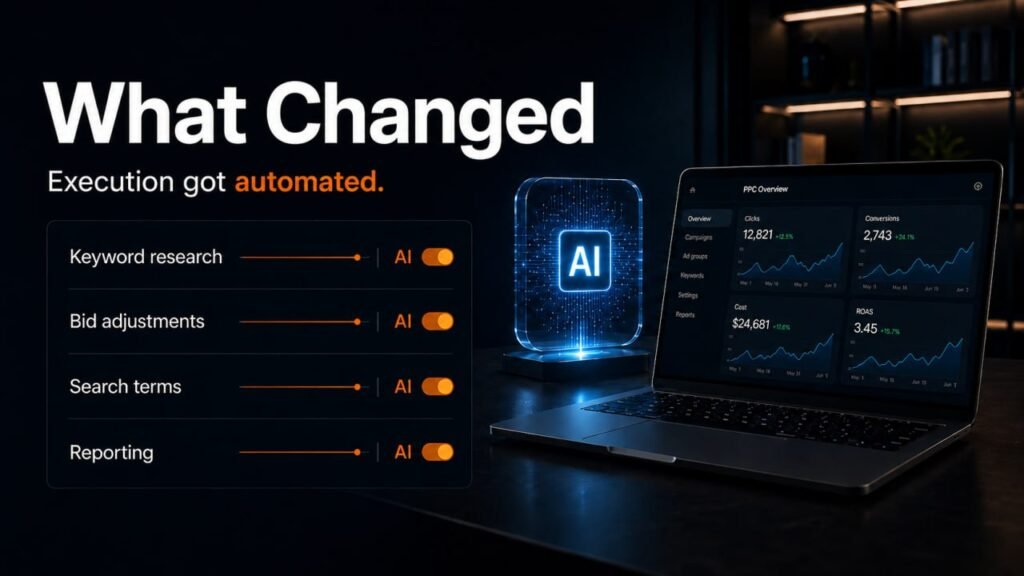
For years, a PPC manager’s day was built around execution: keyword research, bid adjustments, A/B testing, pulling reports, and flagging budget pacing. That work took time, and time was the thing you paid for.
That’s changed. AI tools now pull keywords, adjust bids, and generate standard reports faster than a person doing it by hand, and often more consistently. The same shift is showing up anywhere billing was built around hours: legal work, design, parts of management consulting, but Amazon PPC is a clean example of it, because the tasks that used to fill a manager’s week are some of the easiest to hand to a tool.
This isn’t really about AI being impressive. It’s about what happens when a task that used to require an hour now takes two minutes: whatever you were charging, or paying, for that hour stops being a reasonable ask. A PPC manager whose job was mostly execution is now sitting next to a tool that does the same execution for a fraction of the cost, in less time, without needing a coffee break. That’s not a comment on the person’s skill. It’s just what happens once the routine parts of a job get cheap for everyone at once.
How It Works Now
Here’s where it gets more specific than the general “AI replaces jobs” narrative, because it isn’t that simple.
Most of what gets called “strategy” in Amazon Ads is really a checklist done well: pull the account history, map the competitors, propose a channel split, and put together a quarterly plan. It’s methodical, but it’s not mysterious, and a lot of it follows the same steps every time, regardless of which brand or category it’s for. That kind of repeatable, rules-based synthesis is exactly the work AI now does quickly and cheaply, which means the “strategic value” agencies have leaned on for years is thinning out right alongside execution.
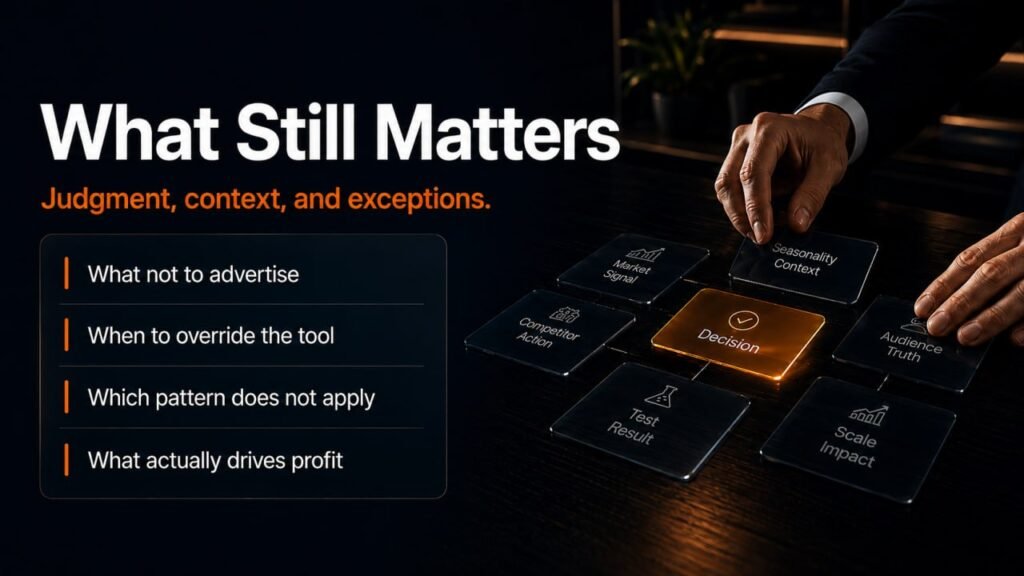
What doesn’t compress is context: the judgment calls that require knowing what to exclude, not just what to include. In Amazon Ads terms, that looks like:
- Deciding which product shouldn’t be advertised at all, no dashboard flags that on its own
- Knowing when a data pattern that worked for one brand doesn’t apply to this one
- Catching the competitive signal that everyone else in the account is reading wrong
- Deciding when to override a tool’s recommendation, and being right often enough that it matters
None of that is about working faster. It’s about knowing what the data can’t tell you.
What It Means for the PPC Manager Role
The job didn’t shrink. It changed shape.
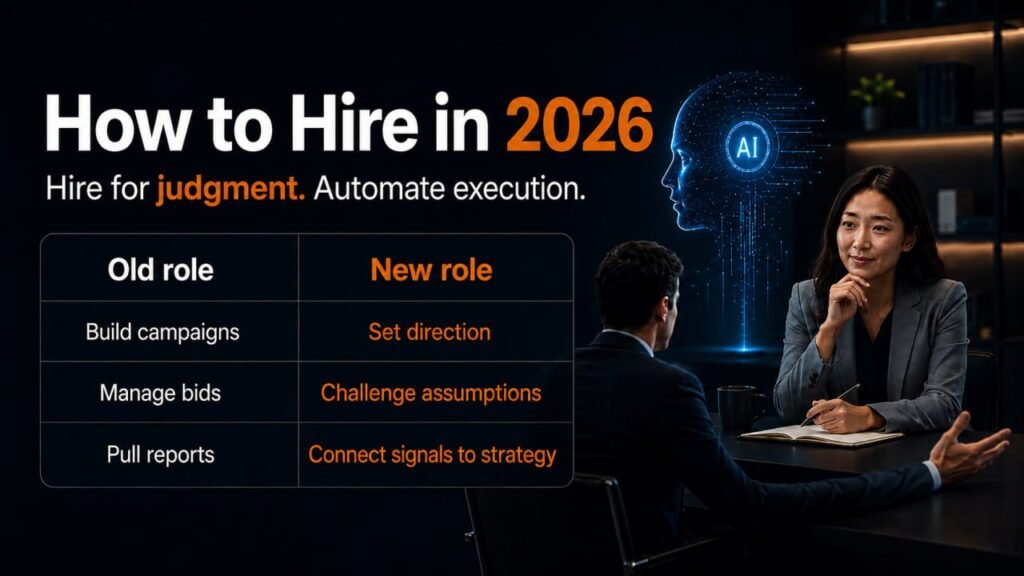
A PPC manager whose value proposition was “I’ll manage your bids and send you a weekly report” is now competing directly with automated tools built for exactly that. A PPC manager whose value proposition is “I know when the data is wrong, and I know what not to spend on” is doing something AI genuinely cannot replicate, because that judgment depends on pattern recognition built across many accounts and situations, not just the one in front of them.
This has a direct effect on hiring. Most Amazon PPC job descriptions were written around a role that’s disappearing: execution-heavy, task-list-driven, judged on volume of work completed. Hiring against that description now gets you someone whose main skill is being reliably replaced by software within a year.
The requirements that should replace it look different: someone who can read AMC or Brand Analytics data and say, correctly, “this pattern doesn’t hold for us,” someone comfortable disagreeing with a tool’s output when the context calls for it, someone who understands the business behind the account well enough to know which growth is real and which is just reallocated demand.
What Brands Should Do
Three practical steps, if this question applies to your team:
- Separate the two layers explicitly. List what your current PPC function actually does. Sort it into “execution and standard reporting” and “judgment calls and exceptions.” Most teams are surprised by how much of the list falls into the first category.
- Rewrite the role before you rewrite the headcount. The instinct is often to cut the seat. The better move is usually to redefine what the seat is for: less time spent on tasks a tool now handles, more time spent on the decisions a tool can’t make.
- Hire against the new definition, not the old job description. If your next hire is meant to own judgment and context rather than execution, screen for that specifically. It’s a different skill set, and it shows up differently in an interview than “can you build a campaign.”
At ANavigator, an Amazon-only advertising agency, this is exactly the line the team has drawn internally. Every account they run sits inside PPC, DSP, AMC, and SQP at once, not one channel in isolation, which is precisely the kind of full-picture judgment that’s hardest to automate and hardest to hire for.
Their proprietary tool, AdOrganix, along with other AI systems, now handles a large share of the execution and reporting layer across the accounts they manage: bid pacing, keyword-level reporting, and standard optimization. Their team spends its time on the judgment layer instead. Deciding which products shouldn’t get spent at all. Reading AMC data to see where demand is actually coming from, not just where it’s reported. Knowing when a DSP signal is worth acting on and when it isn’t. Catching the account-specific pattern that a general tool would miss, because it’s only ever seen this one brand’s history, this one category’s competitive set, this one season’s inventory constraints.
This is also why ANavigator doesn’t sell a flat playbook. A brand doing $150K a month in a seasonal gift category needs a different judgment layer than one doing $400K a month in supplements fighting off cheaper competitors. AI can run the mechanics for both. Figuring out which mechanics matter, and which ones to ignore, is the part the team gets paid for.
Where This Leaves Amazon Brands
None of this means PPC management stopped mattering. It means the part worth paying for has moved. Paying someone by the hour made sense when the hours were doing the work. Once a tool does the same work in minutes, judging a hire on hours spent, or billing a client that way, stops matching what’s actually being delivered.
The question isn’t whether to keep a PPC manager on the team. It’s whether the job description matches the part of the job that’s actually still worth paying for.
Where Does Your Account Actually Stand on This Line?
Every argument above comes down to one practical question: on your account, which tasks have already moved to AI, and which decisions still depend on someone catching what the data doesn’t show on its own? Most brands have never mapped that line, which makes it difficult to know whether a hire or an agency fee is paying for judgment or simply for work a tool already handles.
ANavigator runs AI, including its own tool AdOrganix, across every account it manages, paired with a team trained to know when the tool’s output can be trusted and when it can’t.
For an assessment of where your own account stands, and where a judgment call may be missing, book a Free Account Audit with ANavigator.
Author: Oleksandr Kovalov
Founder & CEO, ANavigator, an Amazon-only advertising agency helping brands scale profitably through PPC, DSP, AMC, and SQP
LinkedIn: https://www.linkedin.com/in/ookovalov/