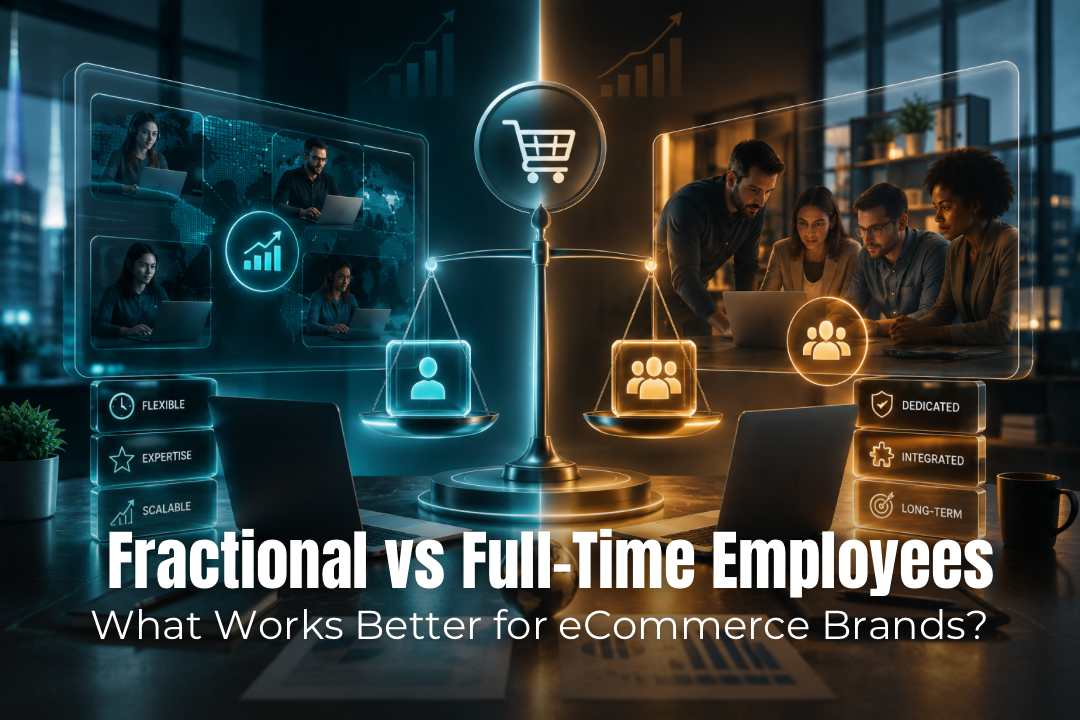
Fractional vs full-time employees is a question many eCommerce founders face as they scale their businesses. Hiring decisions directly impact growth, profitability, team performance, and operational efficiency.
Understanding the differences between fractional vs full-time employees can help you build a stronger team while controlling costs and maintaining flexibility. As the hiring market continues to evolve in 2026, more eCommerce brands are exploring alternative talent models to access specialized expertise without committing to traditional full-time hires.
Whether you’re growing an Amazon business, DTC brand, agency, or marketplace operation, choosing between fractional vs full-time employees depends on your goals, budget, and stage of growth.
In this guide, we’ll explore the advantages, challenges, and ideal use cases for each hiring model.
What Are Fractional Employees?
Fractional professionals are most commonly brought in when a business needs specialized expertise, strategic guidance, or support during a particular stage of growth.
Rather than filling a permanent position, companies often engage fractional professionals to solve specific business challenges, lead transformation projects, improve operations, or provide executive-level expertise that may not be needed on a full-time basis.
Common examples include:
Growth Consultants
Operations Consultants
Supply Chain Consultants
Amazon Marketplace Strategists
Crisis Managers
Change Management Advisors
Business Transformation Consultants
These professionals bring high-level expertise without requiring a long-term full-time commitment.
What Are Full-Time Employees?
Full-time employees work exclusively for one company and are integrated into daily operations.
They typically:
Work standard business hours
Participate in company meetings
Contribute to long-term initiatives
Build institutional knowledge
Develop deeper relationships across teams
Full-time employees often become critical to company culture and long-term business continuity.
For organizations building sustainable growth, full-time hiring remains the foundation of many successful teams.
Why More eCommerce Brands Are Considering Fractional Talent
The hiring market has changed significantly.
Many eCommerce businesses operate in environments where:
Growth can be unpredictable
Margins fluctuate
New platforms emerge rapidly
Specialized expertise is needed quickly
Hiring a senior full-time executive can be expensive and risky.
A fractional professional allows businesses to access expertise immediately while maintaining flexibility.
For example, an Amazon seller preparing for expansion into new marketplaces may need an experienced Amazon Marketplace Strategist for several months to build the growth strategy, optimize operations, and guide execution.
Once the expansion is complete and processes are established, the business may no longer require that level of specialized support on a full-time basis.
This is where the fractional model becomes attractive.
Benefits of Fractional Employees
When comparing fractional vs full-time employees, fractional talent offers several advantages.
Access to senior expertise
Many fractional professionals have years of experience working across multiple companies and industries.
They often bring:
Proven frameworks
Strategic insights
Best practices
Industry connections
Lower hiring costs
Companies typically pay only for the time and expertise they need.
This can significantly reduce:
Salary expenses
Benefits costs
Hiring risks
Faster implementation
Because fractional professionals are often hired for specific challenges, they can start delivering value quickly.
Many businesses use fractional talent to:
Launch new initiatives
Improve operations
Scale revenue channels
Build processes
Greater flexibility
Businesses can increase or reduce involvement as priorities change.
This flexibility is especially valuable during uncertain market conditions.
Challenges of Fractional Employees
While there are benefits, fractional vs full-time employees is not always a straightforward decision.
Fractional talent may present challenges such as:
Limited availability
Because fractional professionals often support multiple clients, their time is naturally divided.
Less company immersion
They may not develop the same level of organizational knowledge as full-time employees.
Communication complexity
Clear expectations and communication processes are essential when working with fractional leaders.
Without proper alignment, execution can suffer.
Benefits of Full-Time Employees
Despite the rise of fractional hiring, full-time employees remain essential for many eCommerce businesses.
Stronger commitment
Full-time employees focus entirely on your business.
This often leads to deeper ownership and accountability.
Long-term knowledge retention
As employees grow with the company, they accumulate valuable institutional knowledge.
This knowledge becomes increasingly important as businesses scale.
Better cultural integration
Full-time team members help shape company culture, collaboration, and communication.
Strong cultures are often built through long-term employee relationships.
Greater operational consistency
Daily involvement creates stronger alignment between strategy and execution.
This consistency is particularly important for operational, customer service, and management functions.
Challenges of Full-Time Employees
The full-time model also comes with limitations.
Higher costs
Beyond salary, businesses often incur costs related to:
Benefits
Equipment
Training
Recruitment
Onboarding
Longer hiring timelines
Finding the right full-time employee can take weeks or even months.
In competitive markets, top candidates are often unavailable quickly.
Higher risk
A poor full-time hire can become costly both financially and operationally.
Replacing employees requires additional time and resources.
Fractional vs Full-Time Employees: Which Roles Work Best?
Some functions naturally fit one model better than the other.
Roles often suited for fractional hiring
Fractional hiring works best when a company needs specialized expertise, strategic guidance, or support during a specific stage of growth.
Common examples include:
Growth Consultant
Operations Consultant
Amazon Marketplace Strategist
Supply Chain Consultant
Finance Consultant
Crisis Manager
Change Management Advisor
For example, a business experiencing declining profitability may bring in a Crisis Manager for several months to identify operational issues, improve financial performance, and stabilize the company. Once the situation is resolved, the business may no longer require that level of expertise on a full-time basis.
Similarly, companies often hire consultants or advisors to support major initiatives such as marketplace expansion, operational restructuring, supply chain optimization, or business transformation projects.
These roles typically focus on solving specific problems, building systems, or providing strategic recommendations rather than managing daily operations long-term.
Roles often suited for full-time hiring
Full-time employees are generally better suited for positions that require ongoing execution, team collaboration, and day-to-day ownership.
Examples include:
Operations Manager
Customer Support Lead
Amazon Account Manager
Brand Manager
Graphic Designer
Project Manager
Marketing Manager
These positions require consistent involvement in the business and benefit from deep knowledge of company processes, products, and team dynamics.
The best choice depends on whether the role is focused on ongoing execution or specialized expertise for a specific challenge or growth stage.
The Hybrid Approach: A Growing Trend in 2026
Many successful eCommerce businesses no longer view fractional vs full-time employees as an either-or decision.
Instead, they combine both models.
A common structure may include:
Full-time operational team members
Fractional consultants or advisors
Specialized experts for strategic projects
External support during periods of rapid growth or organizational change
This hybrid approach allows companies to maintain strong day-to-day execution while bringing in specialized expertise when needed.
As businesses become more agile, hybrid talent strategies continue to gain popularity.
How to Decide What's Right for Your Business
When evaluating fractional vs full-time employees, ask yourself:
What is the business objective?
Do you need strategic guidance or daily execution?
How frequently is the expertise required?
Will the workload justify a full-time position?
What is the budget?
Can the business support a long-term commitment?
How quickly do you need results?
Is this role critical to company culture?
The answers to these questions will help determine the most effective hiring strategy.
Why Hiring Strategy Matters More Than Ever
The most successful eCommerce businesses don’t simply hire more people.
They hire intentionally.
Whether you choose fractional vs full-time employees, the goal should be the same:
Building a team that supports business growth, operational efficiency, and long-term success.
The strongest organizations align hiring decisions with business priorities rather than following trends.
Final Thoughts
The debate around fractional vs full-time employees is becoming increasingly relevant as eCommerce businesses navigate growth, cost pressures, and changing workforce expectations.
Neither model is universally better.
Fractional employees offer flexibility, specialized expertise, and cost efficiency.
Full-time employees provide consistency, deeper integration, and long-term organizational value.
For many brands, the most effective solution is a balanced combination of both.
At Talents Boutique, we see successful eCommerce companies build teams strategically, hiring the right talent model for each stage of growth rather than relying on a one-size-fits-all approach.
The key is not choosing the trendiest option.
The key is choosing the hiring model that best supports your business goals.