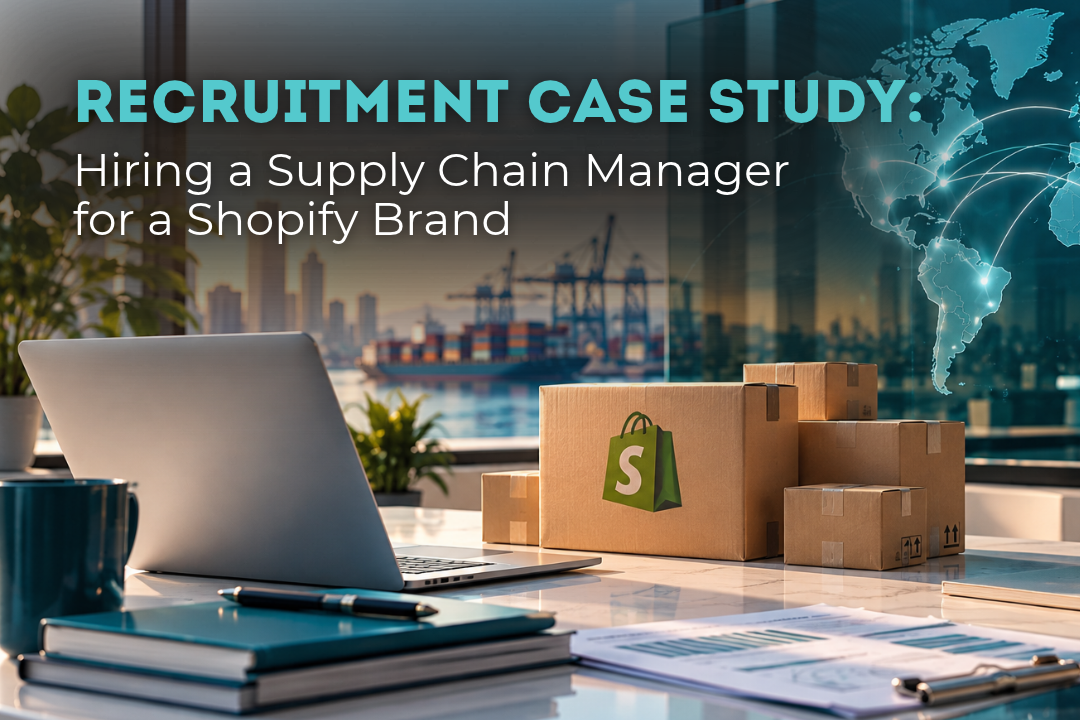
Hiring a Supply Chain Manager becomes particularly challenging when the business handles hundreds of SKUs, works with manufacturers in China, and coordinates regular international shipments. General logistics experience is rarely enough.
In this recruitment case study, Talents Boutique helped an international premium fashion brand find a Supply Chain Manager who could support its growing operations, take ownership of daily workflows, and cover for the Supply Chain Lead when needed.
Case at a Glance
Client | International premium lingerie and leather accessories brand |
Sales platform | Shopify |
Role | Supply Chain Manager |
Core geography | China – US supply chain |
Search duration | 1 month from kickoff to signed offer |
Candidate start | 4 days after the offer was signed |
Hiring outcome | Candidate successfully joined the team and quickly took ownership of operational tasks |
The Client’s Hiring Goal
The Supply Chain Manager position was newly created to support the company’s existing Supply Chain Lead.
The new hire would be responsible for the daily operational side of the supply chain, including:
- managing approved production orders;
- monitoring production schedules and supplier deadlines;
- coordinating international shipments;
- communicating with warehouses and third-party logistics providers;
- maintaining operational reports;
- covering the Supply Chain Lead during her absence.
Independent purchasing and inventory volume planning were not part of the initial scope. However, the specialist needed enough practical experience to work independently once priorities and production orders had been approved.
Why This Supply Chain Search Was Challenging
The difficulty was not simply finding someone with logistics experience.
The company managed a substantial number of SKUs and multiple product variations. Its Supply Chain Manager needed to coordinate several production orders, suppliers, and shipments at the same time without losing sight of deadlines or operational details.
For this reason, we looked beyond job titles. We needed evidence that a candidate had already worked with:
- large product catalogs;
- substantial operational volumes;
- Chinese manufacturers;
- production timelines and quality requirements;
- international freight, particularly shipments from China to the United States;
- Excel or Google Sheets reporting;
- fast-moving eCommerce operations.
Experience in fashion, lingerie, apparel, or accessories was valuable but not mandatory. The client was prepared to provide industry-specific training if the candidate already had a strong operational foundation.
Must-Have and Nice-to-Have Requirements
Must-have experience
The successful candidate needed:
- experience managing a large number of SKUs and significant product volumes;
- hands-on experience communicating with manufacturers in China;
- the ability to follow production progress and hold suppliers accountable for deadlines;
- international logistics experience, particularly with China – US shipments;
- confidence working with numbers, spreadsheets, and operational reports;
- independence, accuracy, and strong attention to detail;
- the ability to adapt quickly to a fast-paced team.
Nice-to-have experience
Additional advantages included:
- experience in fashion, lingerie, apparel, or accessories;
- work with multiple product variations;
- international B2C logistics;
- COGS calculations;
- process improvement or automation experience.
This distinction helped us avoid rejecting strong supply chain professionals simply because they had not previously worked with the client’s exact product category.
Our Search Approach
We combined several sourcing channels:
- the Talents Boutique candidate database;
- direct sourcing on LinkedIn;
- Djinni;
- incoming applications.
The hired candidate was identified through a manual search of our internal database. After reviewing her previous experience, we contacted her directly to introduce the opportunity and assess whether the role matched her background and career expectations.
That manual step mattered. The strongest match did not simply arrive through an application — we found her by examining relevant supply chain experience in detail.
The Selection Process
The assessment process included four stages:
- Interview with a Talents Boutique recruiter
- Interview with the client’s Supply Chain Lead
- Practical assignment
- Final meeting with the Supply Chain Lead to discuss the assignment and cooperation details
The practical assignment allowed the client to evaluate how candidates approached real operational tasks rather than relying only on interview answers.
The Recruitment Funnel
During the one-month search:
- 30 applications were received;
- 85 professionals were directly invited to consider the role;
- 11 recruiter interviews were conducted;
- 8 candidates were presented to the client;
- 1 candidate received and accepted the offer.
The offer was signed exactly one month after the search began, and the selected candidate joined the company four days later.
Why the Selected Candidate Matched the Role
The hired specialist brought six years of experience in eCommerce and supply chain operations.
In her previous position, she had:
- managed approximately 400 SKUs;
- communicated with around 100 Chinese manufacturers each month;
- coordinated the process from supplier sourcing and production to delivery to US facilities;
- monitored samples, inspections, packaging requirements, and shipment readiness;
- arranged weekly China – US shipments by air, fast ocean, and standard ocean freight;
- managed consolidated shipments involving as many as 30 factories and approximately 50 products;
- compared freight forwarder rates and selected logistics partners;
- coordinated third-party inspections in China;
- negotiated supplier compensation for defective products.
Her previous experience was connected to Amazon eCommerce, while the client operated through Shopify. That difference did not undermine her fit because the core operational work — supplier coordination, production management, inspections, freight, and shipment control — closely matched the client’s actual requirements.
During the recruitment process, she also demonstrated the organization, independence, attention to detail, and practical problem-solving ability the role required.
Assessing the Gaps Honestly
The candidate did not match every nice-to-have requirement.
She had not previously coordinated Ukraine – US shipments, while US customs clearance in her former role had been handled by DDP logistics providers. Independent inventory reconciliation, COGS calculations, and advanced reporting had also been outside her responsibilities.
We discussed these gaps rather than presenting her as a perfect-on-paper candidate. None of them outweighed her extensive experience with Chinese manufacturers, high SKU volumes, production coordination, and China – US logistics — the capabilities most important for succeeding in the role.
A useful shortlist should make both strengths and development areas visible. It gives the client a more reliable basis for making the final decision.
The Result
The candidate joined the company only four days after signing the offer.
Approximately one week to ten days after her start, the Supply Chain Lead went on leave. The new employee successfully handled the operational workload during that period and kept the relevant processes moving.
This became an early, practical test of the qualities the client had prioritized: independence, operational discipline, and the ability to cover for the Lead when required.
At the latest client check-in, the candidate had already integrated well into the company’s processes, and the cooperation was progressing successfully. Her probation period was still underway, so we are keeping the result appropriately framed rather than making premature claims about long-term retention.
The candidate also shared positive feedback:
“Everything is going well. The cooperation is running smoothly, and everything is clear. I’m happy, thank you.”
What This Hire Shows
This case demonstrates why eCommerce supply chain recruitment should be based on operational scope rather than identical platforms or job titles.
Amazon experience was not part of the client’s requirements, and the company operated through Shopify. Still, the candidate’s experience managing hundreds of SKUs, coordinating Chinese manufacturers, and organizing frequent China – US shipments was directly transferable.
For employers, the practical lesson is simple: define the operational problems the person must solve before building the candidate profile. Platform experience can matter, but it should not automatically outweigh relevant supply chain complexity, product volume, logistics geography, or evidence of independent execution.