Inventory planning in 2026 should not be a spreadsheet an operations director rebuilds every month. It should be a continuously maintained operating system that connects demand, inventory, lead times, purchasing constraints, and human judgment.
This distinction matters most for ecommerce businesses managing thousands of SKUs. A company with 20 products can inspect each forecast manually. A company with 2,000 products cannot give every SKU the same attention without turning its planning team into spreadsheet operators.
At that scale, the objective is not to remove people from planning. It is to automate the repeatable work so experienced operators can focus on promotions, launches, supply constraints, strategic products, and other exceptions that genuinely require judgment.
Different products need different planning methods
There is no universally correct forecasting model.
A mature evergreen product should not be planned like a new launch. A seasonal gift item should not use the same assumptions as a stable consumable. A product being intentionally sold through should not inherit the growth target assigned to the rest of the catalog.
A scalable forecasting system therefore needs several levels of control:
- A company-level default for most of the catalog
- Product-family settings for groups with similar demand patterns
- SKU-level exceptions for products that behave differently
- Explicit adjustments for promotions, launches, advertising changes, and other planned events
This hierarchy lets the system automate thousands of ordinary decisions without forcing every product into the same model.
Start with a transparent baseline
The first layer should be a repeatable baseline generated from actual sales history, seasonality, and a clearly defined forecasting scenario.
For many established ecommerce businesses, a moderate growth scenario is a practical starting point. From our experience operating eight-figure ecommerce businesses, planning for approximately 10% annual growth often provides a useful balance between protecting product availability and controlling inventory exposure.
A company with stronger, well-supported expansion plans may choose a scenario closer to 20%. But the additional inventory should be backed by real demand-generation investment, supplier capacity, storage capacity, and available working capital.
The important point is that a growth scenario is a planning decision, not a prediction. The system applies the operating assumption selected by the business. Leadership still owns the judgment behind that assumption.
Re-anchor the forecast to actual performance
A forecast should look forward without becoming detached from what the business has achieved.
In NeonPanel, the automatic forecast is refreshed on the 10th of each month and rebuilt for the next 24 months using the latest completed sales data. This creates a rolling plan rather than a forecast that is calculated once and left unchanged for the year.
Consider a business using a 10% growth scenario. If its current sales level is 50% higher than it was three months ago, the refreshed forecast does not continue working from the old, lower starting point. It applies the growth scenario from the new level the business has already reached.
The same mechanism works in the opposite direction. If sales decline, the next refresh begins from the lower observed level instead of continuing to project growth from an outdated baseline.
This monthly re-anchoring keeps the plan responsive while preserving a stable operating philosophy.
A 24-month forecast is still not a 24-month commitment. Forecast uncertainty increases with distance. Near-term periods should drive purchasing decisions, while later periods provide capacity, cash, and supplier-planning direction.
Add what historical data cannot know

Historical data cannot know that the company has booked a Prime Day promotion, increased its advertising budget, secured a wholesale order, changed a listing, or entered a new marketplace.
That information must be added deliberately.
A forecasting agent can help an operator model the expected effect of these events by collecting:
- The affected products or product families
- The promotion or launch dates
- The expected increase in sales
- The relevant channels
- Any ramp-up, cooldown, or post-promotion effects
The operator can review the modeled result before approving it. Once saved, those event-specific values remain in control for the months they cover. The automatic baseline continues to refresh underneath them without replacing the approved adjustments.
Suppose a business normally uses a 10% growth scenario but expects a major promotion in November. The November increase can be modeled separately. When the promotion ends, the following months return to the ordinary growth scenario unless the team has explicitly adjusted them too.
This is a more reliable structure than allowing a temporary promotion to redefine the product’s permanent growth rate.
The forecast is not the replenishment plan
Demand forecasting answers what the business expects to sell. It does not, by itself, answer what the business should order.
Replenishment also requires an accurate understanding of what the company already owns and where those units are. That inventory position should include:
Inventory component | What it covers |
|---|---|
Sellable stock | Units currently available to sell |
Reserved and allocated inventory | Units already committed to specific orders |
Components and materials | Inputs required before assembly or production |
Units currently in production | Stock being manufactured or assembled right now |
Open supplier orders | Purchase orders placed but not yet received |
Inventory in transit | Stock moving between origin and destination |
Stock at company warehouses and 3PLs | Owned stock held outside the company’s own walls |
Inventory at FBA and AWD | Stock held inside Amazon’s fulfillment network |
Transfers and inbound shipments | Stock moving between the company’s own locations |
The cost attached to each batch | The landed cost tied to a specific unit of stock |
A company can have an excellent demand forecast and accurate lead times but still make the wrong purchasing decision if its inventory position is incomplete.
When operations teams cannot confidently establish what they own, overstock often becomes a substitute for visibility. The company buys additional inventory as protection against uncertainty. That may reduce immediate stockout risk, but it also locks working capital into stock, increases storage costs, and raises aged-inventory exposure.
Accurate inventory planning therefore begins with an inventory transaction layer that follows units from the supplier through production, transit, warehouses, fulfillment centers, and eventual sale.
Lead time means the entire replenishment journey
Lead time should not be limited to manufacturing.
The relevant planning window may include:
- Supplier processing
- Manufacturing or assembly
- Quality control
- Origin handling
- Ocean, air, rail, or ground transportation
- Customs clearance
- Receiving at a warehouse or 3PL
- Preparation and forwarding to a marketplace
- FBA or AWD receiving and check-in
Operators should measure actual lead times whenever possible rather than relying exclusively on a supplier’s stated estimate. Variance matters as much as the average. A shipment that usually takes 60 days but sometimes takes 85 days creates a different safety-stock requirement from one that consistently arrives in 60 days.
Supplier-order lead time and FBA replenishment lead time should also remain separate. Ordering from a factory and transferring available stock from a 3PL into FBA are different decisions with different risks.
Traditional replenishment math still matters
Once the business knows what it expects to sell, what inventory it owns, and how long replenishment takes, established inventory mathematics can calculate when another order is required. At its simplest:
Reorder point = Expected demand during lead time + Safety stock
A practical replenishment recommendation also needs to consider:
- Stock on hand
- Inventory already in production or transit
- Open purchase orders
- Supplier and FBA lead times
- Safety-stock targets
- Purchase-order frequency
- Minimum effective order quantities
- Case packs and order multiples
- Warehouse and marketplace destinations
This distinction is important. AI does not replace the underlying replenishment calculation. It makes the calculation easier to interrogate, organize, and act upon.
The mathematics should remain deterministic and reviewable. The agent should explain why a recommendation changed, identify the inputs behind it, and help the operator evaluate the resulting action.
Turn SKU recommendations into purchasing decisions
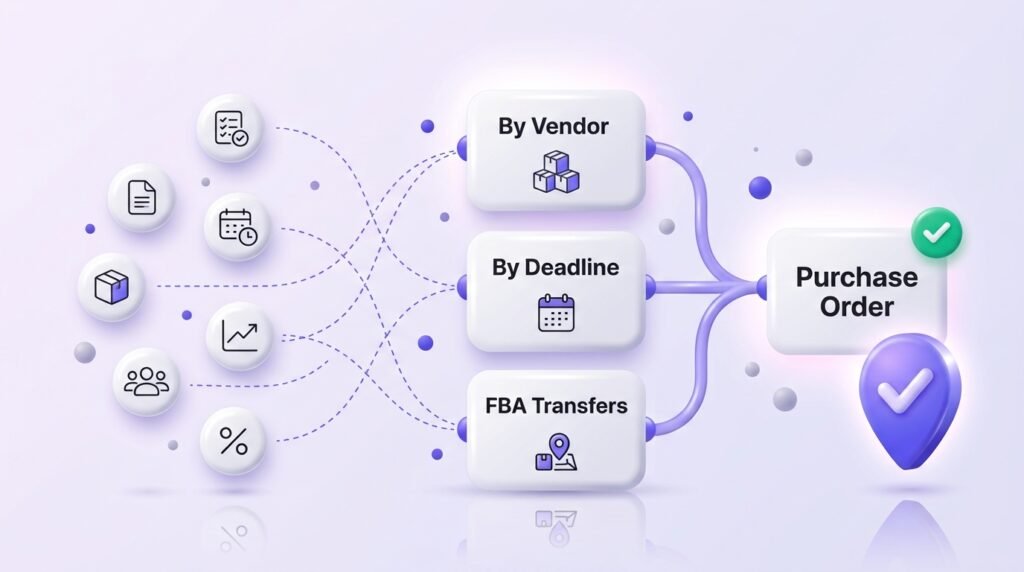
A catalog-wide planning system may produce hundreds of individual SKU recommendations. A purchasing team does not necessarily want to process them as hundreds of unrelated decisions.
A replenishment agent can organize those recommendations into an operating view, such as:
- Products that should be ordered from the same vendor
- Orders approaching their required placement date
- SKUs with rapidly changing days of supply
- Products whose current inventory will not cover their lead time
- Recommendations affected by an upcoming promotion
- Items constrained by minimum order quantities
- FBA transfers that should begin before supplier orders are needed
The agent can also monitor these conditions on a schedule and alert the team when a material change requires attention.
The result should not be autonomous purchasing without oversight. The agent prepares and explains the decision. The operator reviews the assumptions and approves the commitment before cash leaves the business.
Planning teams should manage exceptions, not spreadsheets
The strongest inventory-planning model for a large catalog is an exception-based operating loop:
- Maintain a reliable inventory position across every location and state
- Apply a company-level forecasting scenario to most of the catalog
- Configure family and SKU exceptions where demand behaves differently
- Model promotions, launches, and strategic changes explicitly
- Refresh the baseline from actual sales every month
- Compare planned demand with actual performance
- Calculate replenishment using inventory, lead times, safety stock, and ordering constraints
- Use agents to surface exceptions and organize recommendations into practical actions
- Keep human approval over material purchasing decisions
This structure changes the role of the operations director. Instead of spending most of the planning cycle collecting exports and maintaining formulas, the director can evaluate risk, challenge assumptions, coordinate with marketing and finance, and improve supplier strategy.
That is what inventory planning should look like in 2026: automation for scale, transparent mathematics for control, accurate operational data for confidence, and human judgment applied where it creates the most value.
To learn more about connecting forecasting, inventory visibility, and replenishment in one system, visit Inventory Forecasting and Planning.