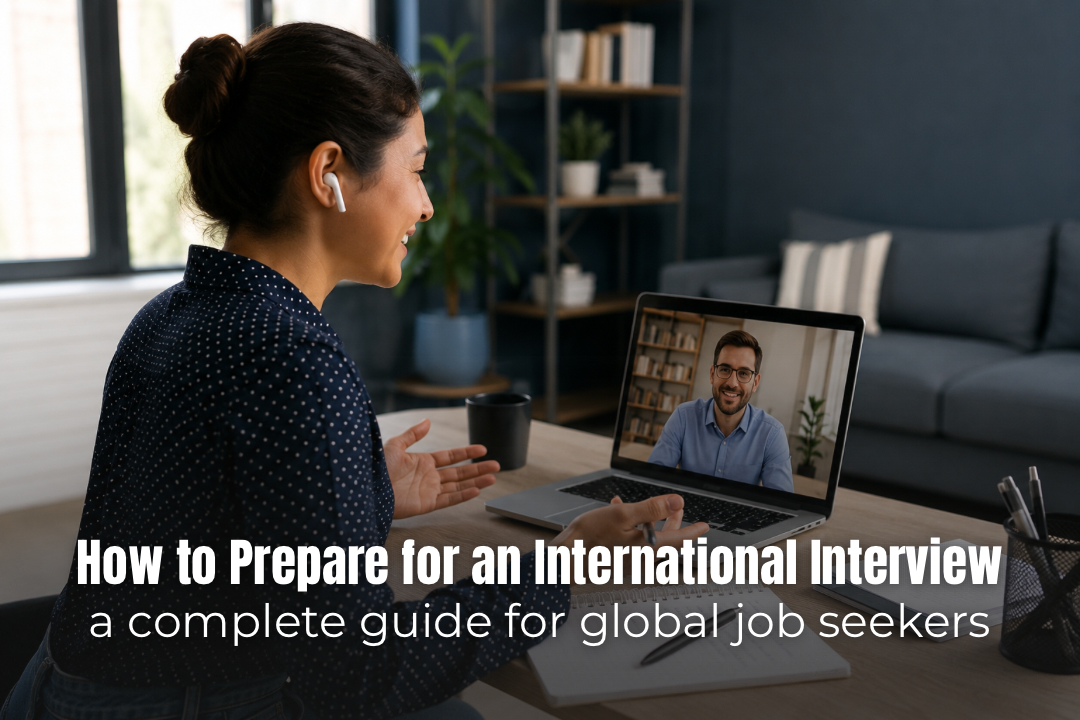
How to prepare for an international interview is one of the most important questions professionals ask when applying for roles with global companies. International interviews often involve different expectations, communication styles, and evaluation criteria than local hiring processes.
Learning how to prepare for an international interview can significantly improve your chances of getting hired. Whether you’re applying for a role in eCommerce, marketing, operations, Amazon, or technology, proper preparation helps you communicate your value clearly and confidently to international employers.
As companies increasingly hire talent across borders, candidates must demonstrate not only professional expertise, but also strong communication skills, business awareness, and cultural adaptability.
This guide explains how to prepare for an international interview and avoid the common mistakes that prevent qualified candidates from securing international opportunities.
Why International Interviews Are Different
Why International Interviews Are Different
Many candidates approach international interviews the same way they approach local interviews.
This is often a mistake.
International global employers typically evaluate more than technical skills. They also assess:
Communication style
Professional maturity
Problem-solving ability
Cultural awareness
Remote work readiness
English proficiency
Business impact
In global teams, your ability to communicate clearly often matters as much as your professional experience.
Understanding how to prepare for an international interview means understanding these broader expectations.
1. Research the Company Thoroughly
One of the easiest ways to stand out during an international interview is to demonstrate genuine knowledge of the company.
Before your interview, research:
The company’s products or services
Business model
Target audience
Leadership team
Recent company news
Competitors
Company values
Many hiring managers begin interviews with simple questions such as:
“What do you know about our company?”
“What interested you about this opportunity?”
Strong candidates answer confidently because they prepared in advance.
Candidates who cannot answer these questions immediately lose credibility.
2. Prepare Your Achievements Using Numbers
2. Prepare Your Achievements Using Numbers
One of the most common interview mistakes is discussing responsibilities instead of results.
International employers want evidence of impact.
Instead of saying:
“I managed Amazon listings.”
Say:
“I optimized over 150 Amazon listings and increased organic sales by 28% within six months.”
Instead of saying:
“I worked on marketing campaigns.”
Say:
“I managed paid advertising campaigns with a monthly budget of $50,000 and improved ROAS by 35%.”
Before the interview, create a list of:
Revenue growth achieved
Products launched
Budgets managed
Teams led
Costs reduced
Conversion improvements
Process optimizations
When preparing for an international interview, numbers are one of your strongest tools.
3. Practice Explaining Your Experience Clearly
3. Practice Explaining Your Experience Clearly
Many professionals have impressive experience but struggle to explain it effectively.
This is especially common during English interviews.
The issue is rarely language itself.
The issue is structure.
A simple framework can help:
— Situation
What was happening?
— Action
What did you do?
— Result
What happened because of your actions?
For example:
“Our Amazon account experienced declining conversion rates. I conducted listing audits, improved product content, and optimized advertising campaigns. Within four months, conversion rates increased by 22%.”
Structured answers sound more professional and are easier for interviewers to understand.
4. Prepare for Behavioral Questions
Behavioral questions are common in international hiring.
Employers want to understand how you think, communicate, and solve problems.
Examples include:
Tell me about a difficult challenge you faced.
Describe a mistake you made.
Tell me about a conflict within your team.
Describe a situation where you showed leadership.
How do you handle feedback?
Many candidates prepare technical answers but ignore behavioral questions.
This can significantly reduce interview performance.
When learning how to prepare for an international interview, make sure you prepare several professional stories that demonstrate:
Leadership
Accountability
Problem-solving
Adaptability
Communication
5. Prepare for Clear Communication
Many candidates with strong professional backgrounds still feel nervous during interviews, especially when interviewing in a language that is not their native language.
The goal is not perfect grammar or a flawless accent.
The goal is clear communication.
International employers understand that many candidates speak English as a second language. What matters most is your ability to:
Explain ideas clearly
Answer questions confidently
Ask thoughtful questions
Communicate your achievements effectively
Before the interview:
Practice speaking your answers out loud
Record yourself answering common questions
Review industry-specific terminology
Rehearse your professional introduction
Strong communication helps interviewers focus on your experience and accomplishments rather than your delivery.
Confidence improves with preparation.
6. Understand What Employers Actually Evaluate
Many candidates assume that interview expectations differ dramatically between countries.
In reality, most international employers evaluate similar core qualities regardless of whether they are based in the United States, Europe, or elsewhere.
They want to understand:
Can you deliver results?
Can you communicate effectively?
Can you solve problems independently?
Can you work well with others?
Can you adapt to change?
The biggest differences often come not from geography, but from company type and company size.
For example:
Large Companies
Larger organizations often have:
More interview stages
More structured evaluation processes
Stronger focus on cultural fit
Additional assessments and stakeholder interviews
Startups and Fast-Growing Businesses
Startups often prioritize:
Adaptability
Ownership
Initiative
Speed of execution
Problem-solving ability
Understanding what a specific company values can help you prepare more effectively than focusing solely on regional differences.
Before every interview, research the company’s size, growth stage, and culture. This will give you a much clearer picture of what interviewers are likely to evaluate.
7. Prepare Your Questions
Strong candidates ask strong questions.
At the end of the interview, prepare questions such as:
What does success look like in this role?
What are the team’s biggest priorities this year?
Why is this position open?
How is performance measured?
What challenges is the company currently facing?
Thoughtful questions demonstrate:
Curiosity
Strategic thinking
Genuine interest
Remember that interviews are two-way evaluations.
You are evaluating the company as much as they are evaluating you.
8. Don't Forget the Logistics
Many candidates underestimate operational preparation.
However, small mistakes create negative impressions.
Before your interview:
Confirm the time zone
Double-check calendar settings
Test your internet connection
Verify microphone and camera functionality
Join a few minutes early
Prepare a quiet environment
In remote international teams, reliability matters.
An interview is often the first demonstration of your organizational skills.
Common International Interview Mistakes
If you want to know how to prepare for an international interview successfully, avoid these common mistakes:
Failing to research the company
Speaking without measurable results
Giving overly long answers
Blaming previous employers
Not preparing questions
Ignoring cultural differences
Underestimating English communication practice
Missing the interview due to time zone confusion
Many qualified candidates lose opportunities because of these avoidable errors.
How Professional Interview Preparation Can Help
Many talented professionals struggle during international interviews, not because they lack experience, but because they struggle to present their experience effectively.
Common challenges include:
Weak CV positioning
Unclear achievement presentation
Lack of interview structure
Low confidence during English interviews
Difficulty explaining business impact
Professional interview preparation can help candidates identify these gaps and improve how they present their real experience to international employers.
At Talents Boutique, we regularly work with candidates pursuing opportunities across the USA, Europe, and LATAM. Through resume reviews, interview simulations, and recruiter feedback, candidates gain a clearer understanding of international hiring expectations and how to communicate their value more effectively.
Final Thoughts
Learning how to prepare for an international interview is no longer optional for professionals pursuing global career opportunities.
International employers look beyond technical skills. They evaluate communication, adaptability, business impact, and professionalism.
Candidates who research companies, prepare measurable achievements, practice structured communication, and understand international expectations consistently perform better during interviews.
The good news is that interview success is rarely about talent alone. In most cases, it is about preparation.
And the better prepared you are, the easier it becomes to demonstrate the value you already bring.